Roman Republic Historical Timeline
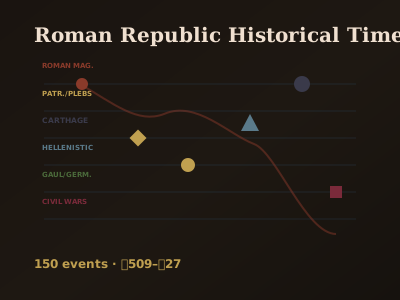
Explore the Roman Republic from its foundation to Augustus. An interactive swimlane timeline covering the Senate, patrician-plebeian struggles, the Punic Wars, the Hellenistic East, Gaul, and the civil wars that ended the Republic.
Roman Republic Historical Timeline is an interactive historical timeline and history map for understanding major events, factions, and chronological context.
- 150 events
- 前509–前27
- 歷史
Overview
Time span: 509–27 BCE Major powers: Roman Senate & magistrates, patricians & plebeians, Carthage, Hellenistic kingdoms, Gaul & Germanic tribes, late Republican warlords Core narrative: Foundation of the Republic, Secession of the Plebs, Twelve Tables, Licinio-Sextian laws, Samnite Wars, Pyrrhic War, three Punic Wars, Macedonian Wars, Gracchi reforms, Marian reforms, Social War, Sulla's dictatorship, Spartacus revolt, Caesar's Gallic Wars, crossing the Rubicon, civil war, Caesar's assassination, Second Triumvirate, Battle of Actium, Octavian becomes Augustus in 27 BCE.
Key events
- Roman Republic Founded — -509
Brutus led a revolt expelling King Tarquinius Superbus ending the monarchy in 510 BCE. In 509 BCE Brutus and Collatinus became first consuls. Power divided between two annually elected officials. The Republic system of d - First Secession of the Plebs — -494
Plebeians suffered debt bondage and political exclusion. Patricians monopolized offices. In 494 BCE plebeians seceded to the Sacred Mount. Patricians created the tribunate. Established mass protest for plebeian rights. T - Twelve Tables of Roman Law — -451
Plebeians demanded written laws. The Decemviri were appointed to codify Roman law. Ten tables drafted in 451 BCE plus two in 450 covering civil criminal religious law. Foundation of Roman law. Codification ended arbitrar - Gallic Sack of Rome — -390
Celtic Gauls swept into Italy advancing on Rome after defeating Etruscan cities. Roman army crushed at Allia. Gauls burned most of the city. The Capitol held out. Rome greatest humiliation fueling later conquest of Gaul. - Licinio-Sextian Laws — -367
After a decade tribunes Licinius and Sextius forced reforms through political deadlock. The laws: one consul must be plebeian; limit public land; debt relief. Decisive plebeian victory creating the patrician-plebeian nob - Samnite Wars Begin — -343
Samnites controlled central Italy. Capua appealed to Rome for help. Three wars from 343 to 290 BCE established Roman dominance over central Italy. Crucial for forging Roman military supremacy in Italy. - Pyrrhic War — -280
Tarentum invited Pyrrhus of Epirus. He brought 25000 men and war elephants. Pyrrhus defeated Rome at Heraclea 280 BCE but at crippling cost. Rome first Hellenistic war showed its resilience. Rome eventually dominated sou - First Punic War Begins — -264
Rome now master of Italy turned to Sicily. Carthage controlled Messana first. In 264 BCE Rome entered Sicily. Carthage declared war. Rome had to build a navy. The war began the century-long struggle for Mediterranean sup - Hannibal Crosses the Alps — -218
Hannibal planned a land route from Spain through Gaul and over the Alps into Italy. In autumn 218 BCE he crossed the Alps losing over half his army to attacks cold and avalanches. One of history greatest military feats. - Battle of Cannae — -216
Rome abandoned Fabian strategy raising 80000 men for a decisive battle at Cannae. In August 216 BCE Hannibal double-envelopment destroyed about 70000 Romans. Classic Cannae. Hannibal greatest victory. Rome worst defeat. - Battle of Zama — -202
Scipio invaded Africa forcing Carthage to recall Hannibal. They met at Zama. Scipio used clever formations to neutralize war elephants then cavalry envelopment. Hannibal first defeat. Zama ended the Second Punic War. Rom - Carthage Destroyed — -146
In the third year of siege Scipio Aemilianus launched the final assault. Famine weakened the city. After six days of street fighting Carthage fell. Of 500000 only 50000 survived. The city was razed. One of the most compl - Tiberius Gracchus Murdered — -133
Tiberius Gracchus tribune proposed land reform. Senate opposed fiercely. In 133 BCE seeking re-election Tiberius was beaten to death by senators at the Capitol. His death marked the first political violence in Rome since - Gaius Gracchus Reforms — -123
Ten years later Gaius Gracchus was elected tribune with a broader reform program. Gaius continued land reform established colonies subsidized grain transferred courts to equestrians. His reforms were among the most radic - Marius Military Reforms — -107
Jugurthine War and Germanic threat exposed the crisis of the property-based levy. Marius recruited the landless poor as volunteers for 16-year terms. The legion was reorganized. The reforms professionalized the army. Sol - Social War — -91
Italian allies demanded Roman citizenship for decades. Tribune Drusus murder sparked revolt. From 91 BCE Italians formed a rival state. After three years Rome granted citizenship to all Italians. The war unified Italy un - Sulla Civil War Begins — -88
Conflict over command against Mithridates escalated into full conflict between Marius and Sulla. In 88 BCE Sulla marched his legions on Rome the first time a Roman army attacked its own city. Sulla march set the preceden - Spartacus Slave Revolt — -73
Gladiator Spartacus escaped from a training school in Capua with 70 followers. Spartacus defeated several Roman armies. Crassus crushed the revolt with 8 legions. Spartacus died. The largest slave revolt in Roman history - Caesar Gallic War — -58
Caesar received command of Cisalpine Gaul and Illyricum. Gallic tribes were uniting. From 58-51 BCE Caesar conquered all of Gaul. The war with Vercingetorix climaxed at Alesia. Caesar wealth and loyal army from Gaul fund - Caesar Crosses the Rubicon — -49
The Senate refused to extend Caesar Gallic command and ordered him to disband. On January 10 49 BCE Caesar led the 13th Legion across the Rubicon River into Italy. Crossing the Rubicon was the point of no return triggeri
Related graphs
Source and editorial notes
This page organizes events into a readable, searchable, and interactive historical timeline. Event selection emphasizes major political changes, wars, reforms, successions, cultural shifts, and cross-period context.