Roman Empire Historical Timeline
Explore the Roman Empire from Augustus to the fall of the West. An interactive swimlane timeline covering the Principate, the Senate, Parthia and Sassanid Persia, Germanic tribes, provincial revolts, and the rise of Christianity.
Roman Empire Historical Timeline is an interactive historical timeline and history map for understanding major events, factions, and chronological context.
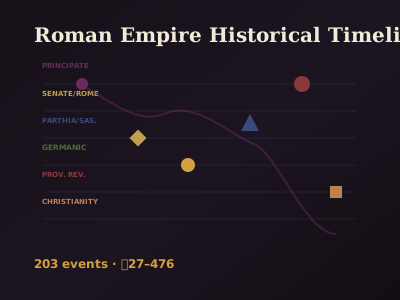
- 203 events
- 前27–476
- 歷史
Overview
Time span: 27 BCE – 476 CE Major powers: Roman Principate & Emperor, Senate, Parthian/Sassanid Empire, Germanic tribes, provinces, Christian Church Core narrative: Augustus establishes the Principate, Julio-Claudian dynasty to Nero, Year of the Four Emperors, Flavian dynasty, Five Good Emperors, Severan dynasty, Crisis of the Third Century, Diocletian's Tetrarchy, Constantine and Christianity, Constantinople founded, Theodosius divides the empire, fall of the Western Roman Empire in 476.
Key events
- Augustus Receives Title Princeps — -27
Octavian defeated Antony and Cleopatra. The Senate granted him 'Augustus' on Jan 16, 27 BCE. On Jan 16 27 BCE the Senate granted Octavian the title Augustus while preserving republican forms. The Augustan Princip - Augustan Settlement — -27
After Actium Octavian became sole ruler and needed a new system to replace the Republic. Augustus established the Principate preserving Senate forms but concentrating military and financial power creating the Praetorian - Battle of Teutoburg Forest — 9
Rome expanded Germania east of the Rhine. Varus was governor implementing Romanization. Arminius pretending Roman ally lured Varus with three legions into an ambush in Teutoburg Forest. This battle halted Roman expansion - Assassination of Caligula — 41
Caligula tyranny caused widespread discontent in Senate and Guard. On Jan 24 41 CE Caligula was assassinated by tribune Cassius Chaerea. The Guard found Claudius and proclaimed him emperor. The assassination showed the e - Claudius Becomes Emperor — 41
After Caligula murder the Guard found Claudius hiding. He was Germanicus brother. The Guard proclaimed Claudius despite Senate republican ambitions. The Senate was forced to accept. Claudius despite disabilities proved a - Great Fire of Rome — 64
On July 18 64 CE a great fire raged in Rome for six days destroying 10 of 14 districts. The cause was unclear. Nero was suspected of arson and blamed Christians beginning persecution. The fire led to urban reforms. Nero - Nero Christian Persecution — 64
After the Great Fire Nero needed scapegoats. Christianity was seen as a foreign superstition. Nero arrested Christians and subjected them to cruel executions crucifixion and human torches. This was the first official per - Year of the Four Emperors — 68
Nero tyranny caused widespread revolt. Vindex in Gaul and Galba in Spain rebelled. The Senate declared Nero a public enemy. He committed suicide. Four emperors followed in succession. The civil wars exposed the fundament - Destruction of Jerusalem Temple — 70
Vespasian left his son Titus to besiege Jerusalem. Jewish factions fought each other inside. Titus breached Jerusalem. The Temple was burned. The inhabitants were killed or enslaved. The Temple destruction was a turning - Nerva Trajan Era Begins — 96
Domitian tyranny led to assassination. The Senate elected elderly Nerva. Nerva adopted the popular general Trajan as his successor beginning adoptive succession. The Nerva Trajan transition began the Five Good Emperors e - Roman Empire at Greatest Extent — 117
After campaigns Trajan expanded Rome to its greatest extent from Britain to Mesopotamia. Trajan fell ill and died in Cilicia. On his deathbed he adopted Hadrian. The empire at maximum extent was difficult to defend. Hadr - Bar Kokhba Revolt — 132
Hadrian building a Roman colony on Jerusalem ruins and a temple to Jupiter enraged Jews. Simon Bar Kokhba led a massive revolt briefly liberating Jerusalem and establishing an independent state. The revolt was brutally c - Marcus Aurelius Becomes Emperor — 161
After Antoninus death Marcus and Verus jointly inherited Rome first co emperorship. Marcus faced multiple crises Parthian war Germanic invasions and the Antonine Plague. Marcus Aurelius the philosopher emperor wrote Medi - Antonine Plague — 165
Roman troops from Parthia brought a deadly disease likely smallpox. The empire had no effective response. The plague spread from army to civilians. Thousands died daily in Rome. Up to one third of population died. The pl - Septimius Severus Becomes Emperor — 193
After Commodus Pertinax was killed. The empire fell into civil war. Five men claimed the throne. Pannonian governor Severus marched on Rome defeated all rivals and disbanded the disloyal Guard. Severus founded the Severa - Crisis of the Third Century — 235
The last Severan emperor was killed by soldiers. The empire fell into 50 years of chaos. The Principate collapsed. Legions proclaimed their own emperors. Civil war invasion and plague struck. The crisis nearly destroyed - Valerian Captured by Shapur — 260
Sassanid Shapur I invaded Rome eastern provinces. Emperor Valerian led a counter attack. Valerian was defeated near Edessa and captured alive the first Roman emperor taken prisoner. His capture was an unprecedented humil - Zenobia and Palmyrene Empire — 269
After Valerian capture Queen Zenobia expanded Palmyra control over Rome eastern provinces. Zenobia took Syria Egypt and parts of Asia Minor. She proclaimed herself Augusta and minted coins. Aurelian defeated Palmyra and - Diocletian Becomes Emperor — 284
After 50 years of crisis the empire neared collapse. Diocletian was proclaimed emperor. Diocletian established the Tetrarchy dividing the empire into East and West. Diocletian reforms saved the empire ending the Crisis o - Diocletian Great Persecution — 303
Diocletian and Galerius saw Christianity as a threat. Christians were about 10 percent of population. Edicts ordered church destruction book burnings arrest of clergy and mandatory sacrifice. This was the last and larges
Related graphs
Source and editorial notes
This page organizes events into a readable, searchable, and interactive historical timeline. Event selection emphasizes major political changes, wars, reforms, successions, cultural shifts, and cross-period context.