Greek City-States Historical Timeline
Explore ancient Greek history from the first Olympic Games to the death of Alexander the Great. An interactive swimlane timeline covering Athens, Sparta, Macedon, the Persian Empire, and the other great city-states.
Greek City-States Historical Timeline is an interactive historical timeline and history map for understanding major events, factions, and chronological context.
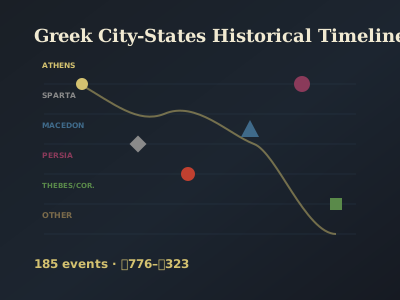
- 185 events
- 前776–前323
- 歷史
Overview
Time span: 776–323 BCE Major powers: Athens, Sparta, Macedon, Persian Empire, Thebes/Corinth & other city-states Core narrative: First Olympic Games, Spartan reforms, tyranny, Solon and Cleisthenes reforms in Athens, Greco-Persian Wars (Marathon, Thermopylae, Salamis, Plataea), Delian League and Peloponnesian War, Spartan and Theban hegemony, rise of Philip II of Macedon, Battle of Chaeronea, Alexander the Great's campaigns to his death in Babylon in 323 BCE.
Key events
- First Olympic Games — -776
The ancient Olympic Games originated from religious sacrifices to Zeus at Olympia. The first recorded games were held in 776 BCE, marking the beginning of the Greek calendar system based on four-year Olympiads. In 776 BC - Lycurgan Reforms in Sparta — -750
By the 8th century BCE, Sparta faced social upheaval after conquering Laconia and Messenia. The existing monarchy could not effectively manage the growing helot population. Sparta urgently needed a new social and militar - Solon's Reforms in Athens — -594
By the early 6th century BCE, Athens faced extreme social crisis. Widespread debt had reduced many farmers to serfdom or debt slavery. Class conflict between aristocrats and commoners threatened civil war. In 594 BCE, So - Peisistratos Becomes Tyrant of Athens — -561
After Solon's reforms, Athens split into three factions: the Plain (aristocratic landowners), the Coast (merchants), and the Hill (small farmers). Peisistratos, leader of the Hill faction, exploited popular disconten - Cleisthenes' Democratic Reforms in Athens — -508
After Hippias was overthrown, fierce power struggles erupted among Athenian aristocrats. Cleisthenes, losing to Isagoras, turned to the common people for support and proposed radical democratic reforms. In 508 BCE, Cleis - Battle of Marathon — -490
Darius I, seeking revenge for Athens' aid to the Ionian Revolt and the burning of Sardis, sent a Persian expeditionary force under Datis and Artaphernes. After destroying Eretria, they landed at Marathon in September - Battle of Thermopylae — -480
In 480 BCE, Xerxes I led a massive Persian army across the Hellespont into Greece. The Greek allies chose to block the narrow pass of Thermopylae while their fleet covered the coastal flank. King Leonidas of Sparta comma - Battle of Salamis — -480
After Thermopylae, Athens was captured and burned. The Greek commanders debated retreat. Themistocles, believing the narrow Salamis Strait favored the Greek fleet, tricked Xerxes into engaging. In September 480 BCE, the - Battle of Plataea — -479
After Salamis, Xerxes returned to Asia but left Mardonius with a large army. Athens was again evacuated as the Persians advanced. Sparta finally dispatched its largest-ever army under Pausanias. In 479 BCE, the Greek arm - Battle of Mycale — -479
In the same month as Plataea, the Greek fleet under Xanthippus pursued the Persian remnants to the coast of Asia Minor. The Persians beached their ships at Mycale and fortified their camp. In August 479 BCE, the Greeks s - Delian League Founded — -478
After the Persian Wars, Sparta withdrew from the anti-Persian coalition, concerned about helot revolts. Athens enthusiastically assumed leadership under the invitation of the Ionian and island Greek cities. In 478/477 BC - Pericles' Golden Age of Athens — -462
After Ephialtes' assassination, Pericles emerged as Athens' undisputed democratic leader. Although nobly born, he championed the common people. He was elected strategos annually from c. 462 to 429 BCE. Pericles&# - Peloponnesian War Begins — -431
Athenian imperial expansion provoked intense resentment among Corinth, Megara, and other Peloponnesian League members. Under allied pressure, Sparta issued ultimatums demanding Athens revoke the Megarian Decree and disba - Sicilian Expedition — -415
Segesta in Sicily appealed to Athens for help against Syracuse. Alcibiades passionately advocated for a massive expedition. Despite Nicias' opposition, the assembly voted to send the largest fleet ever assembled. In - Battle of Aegospotami; Peloponnesian War Ends — -405
With Persian funding, Sparta rebuilt its navy under Lysander. Athens' fleet anchored on the beach at Aegospotami in the Hellespont. Alcibiades warned of the exposed position but was ignored. In 405 BCE, Lysander expl - Rule of the Thirty Tyrants in Athens — -404
After Athens' surrender, Sparta imposed a pro-Spartan oligarchy. Critias and 29 others formed a government, initially promising just rule. The Thirty quickly turned to terror, executing about 1,500 people and confisc - Thirty Tyrants Overthrown; Democracy Restored in Athens — -403
The Thirty Tyrants' brutal reign provoked widespread opposition. Thrasybulus led seventy exiles to seize a fortress, gathering over a thousand men to retake Piraeus. In 403 BCE, Thrasybulus defeated the Thirty's - Corinthian War Begins — -395
Sparta's harsh post-war hegemony provoked widespread resentment. Thebes, Corinth, Argos, and Athens secretly allied against Sparta, with Persian financial backing. In 395 BCE, the coalition launched war against Spart - King's Peace (Peace of Antalcidas) — -387
The Corinthian War left both sides exhausted. Spartan diplomat Antalcidas negotiated directly with the Persian king Artaxerxes II to use Persian power to end the war on Spartan terms. In 387 BCE, the King's Peace was - Battle of Leuctra; Thebes Breaks Spartan Hegemony — -371
By the 370s, Thebes under Epaminondas and Pelopidas had grown powerful enough to challenge Sparta. Spartan king Cleombrotus invaded Boeotia, meeting the Thebans at Leuctra. In 371 BCE, Epaminondas deployed a revolutionar
Related graphs
Source and editorial notes
This page organizes events into a readable, searchable, and interactive historical timeline. Event selection emphasizes major political changes, wars, reforms, successions, cultural shifts, and cross-period context.