Italian Renaissance Historical Timeline
Explore the Italian Renaissance from 1400 to 1530. An interactive swimlane timeline covering Venice, Florence and the Medici, Milan, Naples, the Papal States, and French/Spanish outside pressures.
Italian Renaissance Historical Timeline is an interactive historical timeline and history map for understanding major events, factions, and chronological context.
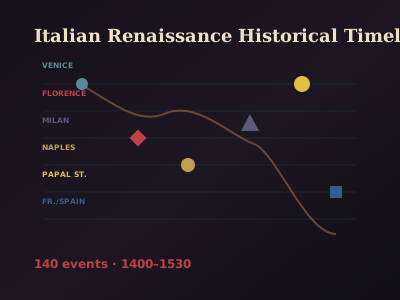
- 140 events
- 1400–1530
- 歷史
Overview
Time span: 1400–1530 Major powers: Venice, Florence/Medici, Milan, Naples, Papal States, French/Spanish outsiders Core narrative: Formation of the five great powers, Medici banking rise, Cosimo and Lorenzo's cultural patronage, Humanism, Peace of Lodi (1454), Borgia papacy, Charles VIII invades (1494), Savonarola's republic, Italian Wars, Machiavelli, Spanish dominance in the south, Sack of Rome (1527), Charles V crowned (1530).
Key events
- Medici Bank Expanded — 1402
Giovanni di Bicci founded Medici Bank in 1397, using papal agency to accumulate wealth. As Camera Apostolica agent, the bank mastered cross-border remittances and deposit banking. Provided capital for Medici politics, se - Gian Galeazzo Visconti Dies — 1402
Gian Galeazzo unified most of Lombardy and controlled central Italy; caught plague while attacking Florence. He died of plague on Sep 3, 1402 at age 50; his expansion plans collapsed instantly. Milan lost its chance; Flo - Council of Constance Ends Great Schism — 1417
Three rival popes existed. Emperor Sigismund pushed for Council of Constance. On Nov 11, 1417, Martin V was elected; three previous popes deposed. Jan Hus was tried and executed. Ended 40-year Western Schism, but Hus exe - Cosimo de Medici Rules Florence — 1434
In 1433 Albizzi exiled Cosimo, but he continued influencing politics through his bank. In Sep 1434 pro-Medici factions won; Cosimo returned. Albizzi purged. Cosimo ruled de facto. Began three centuries of Medici control, - Brunelleschi Completes the Duomo Dome — 1436
Cathedral begun in 1296, stalled for a century over 45m dome. Brunelleschi won 1418 competition. He invented herringbone brickwork and double-shell structure, using 4 million bricks without centering. Foundational Renais - Council of Ferrara-Florence — 1438
Ottoman threat grew; Byzantine Emperor John VIII sought Western aid. Pope Eugene IV convened council. Council met first in Ferrara, moved to Florence due to plague. 1439 Decree of Union signed. Briefly reunited churches - Gutenberg Invents Printing Press — 1450
Gutenberg researched movable type in Mainz, combining metal type, oil ink, screw press. He perfected the press around 1450 and published the 42-line Bible by 1455. Enabled mass knowledge distribution, accelerating Renais - Fall of Constantinople — 1453
Mehmed II determined to conquer Constantinople. Byzantium reduced to one city, West failed to help. Apr-May 1453 siege with massive cannon; city fell May 29. Emperor Constantine XI died. Byzantine Empire fell, marking en - Peace of Lodi — 1454
Long wars among Milan, Venice, Florence, Naples, and Papacy exhausted Italy. On Apr 9, 1454, Venice and Milan signed Peace of Lodi; others joined to form Italian League. Maintained 40 years of peace and balance, creating - Lorenzo de Medici Rules Florence — 1469
Piero died Dec 1469; Lorenzo aged 20 inherited with brother Giuliano, humanist education. Quickly established absolute control, manipulating elections while winning popular support through arts. 23-year rule was Florence - Pazzi Conspiracy Against Medici — 1478
Pazzi family, allied with Pope Sixtus IV, coveted Medici power. On Apr 26, 1478 attacked during Easter Mass at Duomo. Giuliano killed; Lorenzo escaped wounded. Failed plot further consolidated Medici power. Lorenzo brave - Ottomans Capture Otranto — 1480
Mehmed II sought to invade Italy. Ottoman fleet crossed Adriatic toward Naples. Aug 11, 1480 captured Otranto, massacred 800 who refused conversion. Panic across Italy. Ottomans withdrew after Mehmed II death 1481 but th - Lorenzo de Medici Dies — 1492
Lorenzo suffered gout, health declined early 1492. All Italy watched anxiously. Died Apr 8, 1492 at Careggi Villa aged 43, receiving Savonarola blessing. Marked end of Florence golden age. Italian League lost balancer, o - Rodrigo Borgia Elected Alexander VI — 1492
After Innocent VIII death cardinals factionalized. Borgia secured election through bribery. Aug 11, 1492 elected Alexander VI. Openly acknowledged illegitimate children. Notorious for corruption and violent politics. Exp - Columbus Discovers America — 1492
Genoese mariner Columbus sponsored by Isabella and Ferdinand sailed west. Departed Aug 3, 1492, reached Bahamas Oct 12. Columbus believed he reached Asia. Opened European colonization of Americas; gold and silver caused - Charles VIII Invades Italy — 1494
French king claimed Naples. With Lorenzo dead, Ludovico Sforza invited French. Sep 1494 crossed Alps with 30,000 men and artillery, taking Naples Feb 1495. Opened 60-year Italian Wars. Exposed Italian weakness; Spain ent - Savonarola Florentine Republic — 1494
Piero II surrendered when Charles VIII approached. Savonarola called for Christian republic. Medici expelled. Savonarola established Christ-centered republic with moral reforms. Puritan rule about 4 years. Radical reform - Louis XII Conquers Milan — 1499
Louis XII continued Italian policy, claimed Milan through descent, allied with Venice. Summer 1499 French-Venetian forces attacked Milan. Sforza fled. French entered unopposed. Milan under French control. French presence - Battle of Cerignola — 1503
Italian Wars second phase, France and Spain contested Naples. Cordoba led Spanish. Apr 28, 1503 entrenchments and arquebusiers defeated French cavalry. Duke of Nemours killed. Pioneered Spanish Tercio tactic. Spain repla - Michelangelo Paints Sistine Ceiling — 1508
Julius II commissioned Michelangelo to paint Sistine ceiling. Michelangelo was primarily sculptor. 1508-1512 single-handedly painted 500 sq meters, creating Genesis scenes and hundreds of figures. One of Western art grea
Related graphs
Source and editorial notes
This page organizes events into a readable, searchable, and interactive historical timeline. Event selection emphasizes major political changes, wars, reforms, successions, cultural shifts, and cross-period context.