Napoleonic Wars Historical Timeline
Explore the Napoleonic Wars from the Coup of 18 Brumaire to Waterloo. An interactive swimlane timeline covering France, Britain, Prussia, Austria, Russia, and Spain & Portugal.
Napoleonic Wars Historical Timeline is an interactive historical timeline and history map for understanding major events, factions, and chronological context.
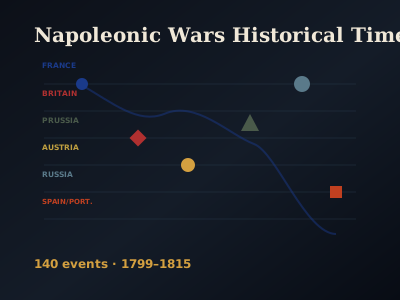
- 140 events
- 1799–1815
- 歷史
Overview
Time span: 1799–1815 Major powers: French Empire, British Empire, Kingdom of Prussia, Austrian Empire, Russian Empire, Spain & Portugal Core narrative: Coup of 18 Brumaire (1799), Battle of Marengo, Peace of Amiens, Napoleon crowned Emperor (1804), Battle of Trafalgar, Battle of Austerlitz, Battle of Jena, Treaty of Tilsit, Peninsular War, Battle of Wagram, 1812 Russian campaign, Battle of Leipzig, fall of Paris and Napoleon's abdication (1814), Congress of Vienna, Hundred Days and Waterloo (1815).
Key events
- Coup of 18 Brumaire — 1799
The Directory faced foreign invasion, domestic rebellion and economic crisis. Napoleon returned from Egypt and overthrew the Directory on November 9, 1799, establishing the Consulate. Napoleon became First Consul, ending - Battle of Marengo — 1800
Napoleon led the Reserve Army across the Alps via Great St Bernard Pass to cut Austrian supply lines. On June 14, 1800, the French initially retreated, but Desaix's timely counterattack routed the Austrians. France r - Treaty of Luneville — 1801
After Hohenlinden, Austria's military was shattered, leading to peace negotiations. Signed February 9, 1801, Austria recognized French control of Belgium and the Rhine's left bank and French client states in Ital - Treaty of Amiens — 1802
Britain fought alone and France needed time to consolidate; both sought peace. Signed March 25, 1802, Britain returned most conquered colonies; France acknowledged British Indian interests. Europe enjoyed a brief peace; - Napoleon Crowned Emperor — 1804
After consolidating power, Napoleon sought an hereditary empire to legitimize his rule. The Senate proclaimed Napoleon Emperor on May 18, 1804; he crowned himself at Notre Dame on December 2, taking the crown from the Po - Napoleonic Code — 1804
France had a patchwork of regional laws; codification had been discussed for years. Promulgated March 21, 1804, the Civil Code enshrined equality before the law, property rights, and secular marriage. The Napoleonic Code - Battle of Trafalgar — 1805
The Franco-Spanish fleet aimed to lure the British away from the Channel to enable Napoleon's invasion. On October 21, 1805, Nelson's 27 ships broke the 33-ship allied line in two columns, winning decisively but - Battle of Austerlitz — 1805
The Third Coalition army assembled in Austria; Napoleon lured them into battle at Austerlitz. On December 2, 1805, Napoleon feigned a retreat and crushed the Allied center, routing the Russo-Austrian army. The Third Coal - Battle of Jena-Auerstedt — 1806
Prussia issued an ultimatum for French withdrawal from Germany; Napoleon attacked preemptively. On October 14, 1806, Napoleon crushed the main Prussian army at Jena while Davout defeated another force alone at Auerstedt. - Continental System — 1806
Unable to defeat Britain at sea after Trafalgar, Napoleon turned to economic warfare. The Berlin Decree of November 21, 1806 declared the British Isles blockaded, banning all trade with Britain. The Continental System ca - Treaties of Tilsit — 1807
After Friedland, Tsar Alexander I sued for peace; the two emperors met on a raft on the Niemen River. Signed July 7-9, 1807, Prussia lost half its territory; Russia recognized French hegemony and joined the Continental S - Peninsular War Begins — 1808
Napoleon invaded Portugal through Spain then occupied Spain, sparking nationwide resistance and British intervention. In March 1808 French troops occupied Madrid; on May 2 the city rose up, revolts spread across Spain, a - Battle of Wagram — 1809
Austria launched the Fifth Coalition while Napoleon was tied down in Spain; Napoleon massed his forces near Vienna. On July 5-6, 1809, after fierce artillery duels and close combat, the French broke the Austrian lines, f - Napoleon Invades Russia — 1812
To force Russia back into the Continental System, Napoleon assembled the largest army in European history to invade Russia. On June 24, 1812, Napoleon led about 600,000 men across the Niemen River; the Russians retreated - Battle of Borodino — 1812
After weeks of retreat, Kutuzov chose a position near Borodino, 120 km west of Moscow, to make a stand. On September 7, 1812, the French launched repeated massive assaults on Russian defenses; about 100,000 casualties oc - The Hundred Days — 1815
Dissatisfied with exile and sensing Bourbon weakness, Napoleon decided to return and reclaim power. From March 1 landing to June 22 abdication, Napoleon ruled France for about 100 days, culminating in Waterloo. Though br - Battle of Waterloo — 1815
Napoleon pursued Wellington's army to Mont-Saint-Jean ridge south of Waterloo for a decisive battle. On June 18, 1815, French assaults failed to break the British line; the Imperial Guard's final charge was repul - Napoleon Exiled to Saint Helena — 1815
After Waterloo, Napoleon abdicated again; Britain exiled him to the remote South Atlantic island of Saint Helena. On July 15, 1815, Napoleon surrendered to HMS Bellerophon; he reached Saint Helena on October 15, living a - Battle of Leipzig — 1813
After the Russian disaster, the Sixth Coalition assembled a massive army to confront Napoleon at Leipzig. From October 16-19, 1813, about 500,000 allied troops encircled the French; after four days the French broke, with - Napoleon Abdicates and Exiled to Elba — 1814
The allies invaded eastern France; Paris fell; Napoleon's marshals refused to fight on and forced him to abdicate. On April 6, 1814, Napoleon signed the abdication at Fontainebleau; the Treaty of Fontainebleau exiled
Related graphs
Source and editorial notes
This page organizes events into a readable, searchable, and interactive historical timeline. Event selection emphasizes major political changes, wars, reforms, successions, cultural shifts, and cross-period context.