British Isles Historical Timeline
Explore the British Isles from the Norman Conquest to the Tudor accession. An interactive swimlane timeline covering England, Scotland, Wales, Ireland, and the Angevin Empire.
British Isles Historical Timeline is an interactive historical timeline and history map for understanding major events, factions, and chronological context.
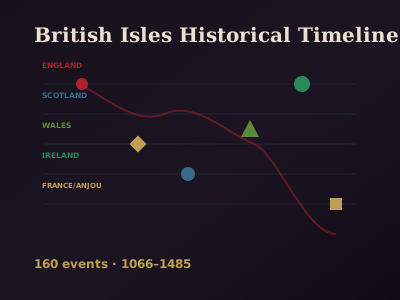
- 160 events
- 1066–1485
- 歷史
Overview
Time span: 1066–1485 Major powers: Kingdom of England, Kingdom of Scotland, Principality of Wales, Lordship of Ireland, Angevin Empire Core narrative: Battle of Hastings and Norman Conquest (1066), Domesday Book (1086), The Anarchy, Henry II and the Angevin Empire, Becket murder, Magna Carta (1215), Barons' War and Parliament, Edward I conquers Wales, Scottish Wars of Independence, Hundred Years' War (Crécy, Poitiers, Agincourt), Black Death, Peasants' Revolt, Wars of the Roses, Battle of Bosworth and Tudor accession (1485).
Key events
- Battle of Hastings — 1066
Duke William of Normandy landed at Hastings, facing Harold's weary army. Norman cavalry and archers broke the Saxon shield wall; Harold was killed. Norman conquest succeeded; William crowned king, ending Anglo-Saxon - Coronation of William the Conqueror — 1066
After Hastings victory, William marched to London to claim the crown. William was crowned King of England at Westminster Abbey on Christmas Day. Norman dynasty established, beginning feudalism and Normanization of Englan - Domesday Book — 1086
William needed a comprehensive survey of England's land for taxation. Royal commissioners traveled across England recording land ownership, value, and population. Domesday Book became the most comprehensive medieval - The Anarchy — 1135
After Henry I's death, Matilda and Stephen fought for the crown. Stephen seized coronation; Matilda launched a civil war lasting 19 years. England descended into lawlessness; ended with the Angevin dynasty. - Henry II Becomes King — 1154
Stephen and Matilda agreed that Matilda's son Henry would inherit the throne. Henry II crowned, establishing the Angevin Empire. Plantagenet era began; Henry II's reforms laid foundation for common law. - Murder of Thomas Becket — 1170
Henry II and Archbishop Becket clashed over church jurisdiction. Henry's angry words led four knights to murder Becket in Canterbury Cathedral. Becket became a saint; Canterbury became a pilgrimage site; Henry II rep - Magna Carta Signed — 1215
John's tyranny and military failures triggered baronial rebellion. Rebel barons forced John to sign Magna Carta at Runnymede. First legal limit on royal power; established due process and rule of law. - Montfort's Parliament — 1264
Simon de Montfort captured the king after the Battle of Lewes. Montfort summoned a parliament that included knights and burgesses. Began the House of Commons; origin of English parliamentary democracy. - Edward I Conquers Wales — 1277
Llywelyn ap Gruffudd refused to pay homage to Edward I. Edward launched two campaigns (1277 and 1282-83), defeating Llywelyn. Wales annexed by England; ring of castles built; Prince of Wales title established. - Battle of Stirling Bridge — 1297
William Wallace led a Scottish uprising against English rule. Wallace defeated the English at Stirling Bridge using terrain advantage. Wallace became the symbolic leader of Scottish independence. - Battle of Bannockburn — 1314
Edward II led a huge army north to relieve Stirling Castle. Bruce's schiltron formations defeated the much larger English army. Scottish independence secured; Bruce became national hero. - Treaty of Edinburgh-Northampton — 1328
After 20+ years of war, England acknowledged Scotland's victory. England formally recognized Scotland's full independence. Scotland gained full sovereignty; peace lasted briefly. - Hundred Years' War Begins — 1337
Edward III claimed the French throne, declaring war on Philip VI. Edward III asserted his claim as King of France, starting the war. The 116-year conflict transformed both kingdoms. - Battle of Crécy — 1346
Edward III marched through northern France; Philip VI pursued. English longbowmen decimated French cavalry charges at Crécy. Longbow proved decisive; war tilted in England's favor. - Black Death Arrives in England — 1348
The plague arrived in England's ports via merchant ships in 1348. Black Death swept across England, killing one-third to half the population. Labor shortages caused serfdom decline and deep socio-economic change. - Battle of Poitiers — 1356
The Black Prince conducted a chevauchée from southern France. English longbows defeated the French at Poitiers; King John II captured. Huge ransom for the French king; war decisively tilted toward England. - Peasants' Revolt — 1381
Poll taxes, labour laws, and post-plague discontent sparked rebellion. Wat Tyler and John Ball led peasants in a march on London. Though crushed, the revolt showed the political power of commoners. - Henry IV Usurps the Throne — 1399
Richard II's tyranny angered the nobles; Henry Bolingbroke raised an army. Henry returned from exile, imprisoned Richard II, and crowned himself king. Lancastrian dynasty began; usurpation sowed seeds for the Wars of - Battle of Agincourt — 1415
Henry V invaded France and was intercepted by the main French army at Agincourt. English longbowmen won a stunning victory against French cavalry in muddy terrain. One of England's greatest victories; Henry V went on - Joan of Arc Relieves Orléans — 1429
English forces besieged Orléans; France was on the verge of collapse. Peasant girl Joan of Arc led French forces to relieve Orléans and crown Charles VII. Joan turned the tide of the Hundred Years' War, becoming a Fr
Related graphs
Source and editorial notes
This page organizes events into a readable, searchable, and interactive historical timeline. Event selection emphasizes major political changes, wars, reforms, successions, cultural shifts, and cross-period context.