Crusades Historical Timeline
Explore the Crusades from the Council of Clermont to the fall of Acre. An interactive swimlane timeline covering the Crusader states, the Papacy, Byzantium, Ayyubid and Mamluk Egypt-Syria, and European kings' crusades.
Crusades Historical Timeline is an interactive historical timeline and history map for understanding major events, factions, and chronological context.
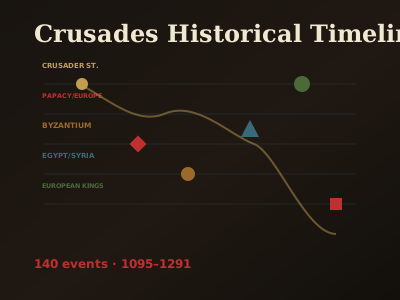
- 140 events
- 1095–1291
- 歷史
Overview
Time span: 1095–1291 Major powers: Crusader states (Jerusalem, Antioch, Tripoli, Edessa), Papacy, Byzantine Empire, Ayyubid/Mamluk dynasties, European kingdoms Core narrative: Council of Clermont (1095), First Crusade captures Jerusalem (1099), fall of Edessa (1144), Second Crusade, Saladin's unification, Battle of Hattin (1187), Third Crusade, Fourth Crusade sacks Constantinople (1204), Children's Crusade (1212), Fifth through Eighth Crusades, Baibars and the Mamluks, fall of Acre (1291).
Key events
- Council of Clermont — 1095
Byzantine Emperor Alexius I appealed to the West for help against the Seljuk threat in 1095. Pope Urban II sought to assert papal authority and heal the East-West schism. Urban II delivered a powerful sermon at Clermont, - People's Crusade — 1096
After Clermont, preacher Peter the Hermit organized a mostly peasant army lacking training and supply lines, heading east in religious fervor. Thousands marched through Hungary and Byzantium, pillaging along the way. Upo - First Crusade Conquest — 1097
Noble crusader armies marched east in 1096-97, gathering in Constantinople. Alexius I demanded reconquest of lost lands while crusaders harbored independent ambitions. They captured Nicaea, defeated Seljuks at Dorylaeum, - Kingdom of Jerusalem Founded — 1099
After Jerusalem's capture on July 15, 1099, the crusaders faced establishing stable governance. Latin nobles debated fiercely before creating a monarchy. Godfrey of Bouillon was elected Defender of the Holy Sepulchre - Fall of Edessa — 1144
The County of Edessa, easternmost and most isolated crusader state, was vulnerable. Zengi exploited internal crusader conflicts and the regency crisis in Jerusalem. Zengi besieged Edessa in November 1144. After undermini - Second Crusade — 1145
After Edessa's fall, Pope Eugenius III issued a crusade bull. Bernard of Clairvaux preached enthusiastically, recruiting King Louis VII of France and King Conrad III of Germany. Conrad's German army was crushed b - Battle of Hattin — 1187
In 1187 Saladin assembled a massive army to invade Jerusalem. King Guy gathered the kingdom's full force of about 20,000 men after Raymond's reconciliation, but command was chaotic and supplies insufficient. Sala - Fall of Jerusalem (1187) — 1187
After Hattin, Saladin captured coastal cities including Acre, Jaffa, and Caesarea. Jerusalem's defenses were inadequate and its garrison tiny; Balian of Ibelin hastily organized defense. Saladin besieged Jerusalem; t - Third Crusade — 1189
After Jerusalem's fall, Pope Gregory VIII issued a crusade bull. Three of Europe's mightiest monarchs answered: Frederick Barbarossa, Philip II of France, and Richard I of England. Frederick drowned in Anatolia, - Fourth Crusade — 1202
Pope Innocent III called the Fourth Crusade, targeting Egypt. The crusaders contracted Venetian transport but lacked payment. Doge Enrico Dandolo proposed capturing Zara as payment. First capturing Christian Zara (1202), - Sack of Constantinople (1204) — 1204
In 1203 the crusaders first besieged Constantinople, restoring Isaac II and young Alexius IV. The new emperor could not fulfill enormous promises to the crusaders, causing relations to collapse. On April 13, 1204, crusad - Children's Crusade — 1212
In 1212 a religious frenzy swept France and Germany: thousands of children set out for the Holy Land, believing their purity could achieve what force could not. Stephen of Cloyes led French children to Marseille, where s - Fifth Crusade — 1217
Pope Innocent III and his successor Honorius III continued crusade preaching. Duke Leopold VI of Austria and King Andrew II of Hungary led initially, targeting Egyptian Damietta. Crusaders besieged and captured Damietta - Sixth Crusade — 1228
Holy Roman Emperor Frederick II had vowed to crusade but repeatedly delayed, earning excommunication by Pope Gregory IX. In 1228 he sailed despite the ban, aiming for diplomatic rather than military reconquest of Jerusal - Jerusalem Lost (1244) — 1244
After the 1229 treaty expired, Jerusalem was again vulnerable. Khwarezmian horsemen, displaced by Mongols in Central Asia, migrated west and were hired by Egyptian Sultan al-Salih. In July 1244, Khwarezmians captured the - Seventh Crusade — 1248
Shocked by Jerusalem's loss, King Louis IX of France vowed to crusade. He spent four years raising funds and assembling an army, targeting Egypt. Crusaders captured Damietta in 1249, then advanced on Cairo. At Mansur - Battle of Ain Jalut — 1260
After capturing Baghdad in 1258 and destroying the Abbasid Caliphate, the Mongols continued westward. By 1259 they took Aleppo and Damascus; Mamluk Egypt was Islam's last bastion. On September 3, 1260, Mamluk Sultan - Fall of Antioch (1268) — 1268
After becoming Mamluk sultan, Baibars launched full-scale attacks on crusader states. The Principality of Antioch, once a crusader powerhouse, had severely declined and was isolated. In May 1268, Baibars besieged Antioch - Eighth Crusade — 1270
Louis IX organized another crusade to redeem his earlier failure. His brother Charles of Anjou, newly crowned King of Sicily, encouraged an attack on Tunis to expand Mediterranean influence. Crusaders landed on the Tunis - Fall of Tripoli (1289) — 1289
After Baibars' death, Mamluk Sultan Qalawun continued expansionist policies. The County of Tripoli, the last major crusader stronghold in northern Levant, was severely divided internally. In April 1289, Qalawun besie
Related graphs
Source and editorial notes
This page organizes events into a readable, searchable, and interactive historical timeline. Event selection emphasizes major political changes, wars, reforms, successions, cultural shifts, and cross-period context.