Holy Roman Empire Historical Timeline
Explore a thousand years of the Holy Roman Empire from Charlemagne to its dissolution. An interactive swimlane timeline covering the Emperor-Papacy relationship, Saxony and Franconia, Hohenstaufen, Habsburg, Italian cities, and the Slavic east.
Holy Roman Empire Historical Timeline is an interactive historical timeline and history map for understanding major events, factions, and chronological context.
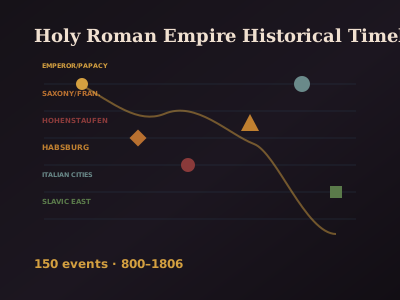
- 150 events
- 800–1806
- 歷史
Overview
Time span: 800–1806 Major powers: Holy Roman Emperor, Papacy, Saxony/Franconia, Hohenstaufen, Habsburg, Italian city-states, Slavic peoples Core narrative: Charlemagne crowned (800), Treaty of Verdun, Otto I crowned (962), Investiture Controversy, Canossa (1077), Concordat of Worms (1122), Frederick Barbarossa, Great Interregnum, Rudolf of Habsburg, Golden Bull (1356), Habsburg lock on crown, Reformation, Schmalkaldic War, Augsburg Peace (1555), Thirty Years' War, Peace of Westphalia (1648), dissolution (1806).
Key events
- Charlemagne Crowned Emperor — 800
Pope Leo III sought Frankish protection Leo III crowned Charlemagne at St. Peter's Founded HRE, established papal coronation - Treaty of Verdun — 843
Three sons of Louis the Pious fought Treaty divided empire into three parts Laid foundations for France, Germany, Italy - Otto I Crowned Emperor — 962
Otto I intervened in Italy; Pope John XII sought help Otto crowned HRE in Rome Holy Roman Empire formally established - Walk to Canossa — 1077
Henry IV excommunicated, princes threatened Henry IV stood barefoot in snow for three days Excommunication lifted but royal power severely weakened - Concordat of Worms — 1122
Fifty-year investiture struggle Henry V and Pope Calixtus II reached agreement Pope got spiritual investiture, emperor kept temporal power - Frederick Barbarossa Becomes King — 1152
Conrad III recommended Frederick Frederick I elected King of Germany Hohenstaufen dynasty reached its zenith - Battle of Legnano — 1176
Lombard League challenged imperial army Lombard League defeated Frederick I Confirmed autonomy of Italian cities - Great Interregnum Begins — 1198
Succession crisis after Henry VI's death Hohenstaufen and Welf candidates competed for throne Imperial authority collapsed, princes' power grew - Rudolf I Elected King — 1273
Princes desired stability after Interregnum Rudolf of Habsburg elected King of Germany Ended Interregnum, Habsburgs began their rise - Golden Bull of 1356 — 1356
Imperial election system needed regulation Charles IV issued the Golden Bull Fixed seven prince-electors, regulated election procedure - Habsburg Lock on Imperial Throne — 1438
Sigismund died, Habsburgs rose to power Albert II elected king, throne passed to Habsburgs Habsburgs held throne until 1806 - Luther's 95 Theses — 1517
Indulgence abuse sparked discontent Luther posted theses on Wittenberg church door Began German Reformation - Diet of Worms 1521 — 1521
Luther's teachings spread rapidly Charles V summoned Luther to recant Luther declared heretic, religious division deepened - Schmalkaldic War — 1546
Religious tensions peaked Charles V defeated Protestant prince alliance Protestants temporarily defeated - Peace of Augsburg — 1555
Religious war reached stalemate Augsburg Diet established cuius regio, eius religio principle Lutheranism legally recognized - Thirty Years' War Begins — 1618
Bohemian revolt spread rapidly Habsburgs at war with opposition across Europe One of Europe's deadliest religious wars - Defenestration of Prague — 1618
Bohemian Protestants resisted Habsburg rule Protestants threw imperial governors out of window Directly triggered the Thirty Years' War - Peace of Westphalia — 1648
Thirty Years' War exhausted Europe Twin treaties of Münster and Osnabrück Established sovereign state system, further weakened Empire - War of Spanish Succession — 1701
Spanish Habsburg line died out Bourbon France vs Habsburg Austria over Spanish throne Austria gained Italian and Netherland territories - War of Austrian Succession — 1740
Charles VI died, Prussia challenged succession Maria Theresa defended her throne War of Austrian Succession
Related graphs
Source and editorial notes
This page organizes events into a readable, searchable, and interactive historical timeline. Event selection emphasizes major political changes, wars, reforms, successions, cultural shifts, and cross-period context.