Iberian Reconquista Historical Timeline
Explore the Iberian Peninsula from the Muslim conquest to the fall of Granada. An interactive swimlane timeline covering Castile, Aragon, Portugal, Navarre, and Al-Andalus.
Iberian Reconquista Historical Timeline is an interactive historical timeline and history map for understanding major events, factions, and chronological context.
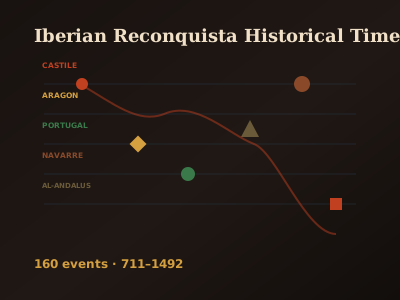
- 160 events
- 711–1492
- 歷史
Overview
Time span: 711–1492 Major powers: Castile, Aragon, Portugal, Navarre, Al-Andalus/Umayyad, Almoravids/Almohads Core narrative: Muslim conquest of Visigothic Spain (711), Umayyad Emirate of Córdoba, Caliphate of Córdoba, Taifa kingdoms, Almoravid and Almohad unification, Christian northward expansion, fall of Toledo (1085), Battle of Las Navas de Tolosa (1212), Granada War, fall of Granada (1492).
Key events
- Battle of Guadalete — 711
In 711, Muslim forces under Tariq ibn Ziyad crossed the Strait of Gibraltar into Iberia. The Visigothic Kingdom was in a succession crisis. Tariq led about 12,000 men against King Roderic near the Guadalete River. The Vi - Umayyad Emirate of Cordoba Founded — 756
Umayyad prince Abd al-Rahman I escaped Abbasid persecution reaching Al-Andalus. Abd al-Rahman was proclaimed emir in Cordoba defeated rivals and unified Al-Andalus. The emirate began three centuries of independent develo - Caliphate of Cordoba Proclaimed — 929
After crushing rebels Abd al-Rahman III sought legitimacy against Fatimid and Abbasid caliphs. He proclaimed the Caliphate of Cordoba styling himself Caliph. Cordoba became one of the greatest centers of medieval Islamic - Collapse of the Caliphate of Cordoba — 1009
The Fitna destroyed the central government leaving the caliphate a shell. In 1031 Cordoba's nobles abolished the caliphate regional governors declared themselves Taifa kings. Fragmentation allowed Christian kingdoms - Toledo Captured by Alfonso VI — 1085
Alfonso VI exploited Toledo's internal divisions and pressured it into surrender. Alfonso entered Toledo peacefully preserving buildings and promising religious freedom. Toledo became the capital of Castile and a cen - Battle of Sagrajas (Zallaqa) — 1086
After Toledo fell Seville's al-Mutamid called the Almoravids for help Yusuf crossed the strait. The armies met near Badajoz Yusuf feigned retreat then crushed Alfonso's forces. The battle halted Castilian advance - Battle of Ourique — 1139
Portuguese count Afonso Henriques faced Almoravid forces south of the Duero. Afonso won a stunning victory legend says Christ appeared promising Portuguese independence. Afonso proclaimed himself king Portugal emerged as - Lisbon Captured by Afonso I — 1147
Afonso Henriques used the Second Crusade's English and German fleets to besiege Lisbon. Portuguese and Crusader forces besieged Lisbon for months it fell on October 24. Lisbon became Portugal's capital laying the - Castile Formally Becomes a Kingdom — 1179
Though a de facto kingdom Castile's legal status evolved over time. Pope Alexander III formally recognized Castile as a kingdom no longer subordinate to Leon. Castile became a fully sovereign kingdom future leader of - Battle of Alarcos — 1195
Alfonso VIII advanced deep into Almohad territory meeting Caliph Abu Yusuf at Alarcos. Alfonso was outmaneuvered and crushed Castilian losses were enormous. The disaster forced Castile to sue for peace the Reconquista su - Battle of Las Navas de Tolosa — 1212
Alfonso VIII assembled a Christian coalition including Aragon Navarre and crusaders against the Almohad caliph. The coalition met the Almohads at Las Navas Christian knights broke through the caliph fled. The decisive ba - Cordoba Falls to Castile — 1236
Castilian king Fernando III exploited Al-Andalus divisions to attack Cordoba. Castilian forces besieged Cordoba the Muslim garrison surrendered Fernando entered the city. The former Umayyad capital returned to Christian - Seville Falls to Castile — 1248
Fernando III besieged Seville with Castilian forces and a naval blockade of the Guadalquivir. After 16 months Seville surrendered due to hunger Fernando entered peacefully. The largest city of Al-Andalus returned to Chri - Battle of Rio Salado — 1340
The Nasrids and Marinids launched a joint attack on Castile's southern frontier. Alfonso XI of Castile with Portuguese allies defeated the coalition near Tarifa. The battle ended Marinid intervention in Iberia securi - Granada War Begins — 1481
Isabella of Castile and Ferdinand of Aragon decided to conquer Granada completing the Reconquista. The war began after a Nasrid raid on Zahara Castile-Aragon launched a full-scale campaign. The ten-year war was the final - Granada Surrenders — 1492
After ten years of war Granada was besieged and starved into surrender. Boabdil handed over the city keys Ferdinand and Isabella entered the Alhambra. The fall of Granada ended nearly 800 years of Muslim rule in Iberia - Marriage of Isabella and Ferdinand — 1469
Castilian princess Isabella married Aragonese prince Ferdinand secretly in Valladolid. The marriage needed papal dispensation due to consanguinity. The union paved the way for Spanish unification creating the foundation - Castilian Succession Crisis — 1462
Henry IV faced a succession crisis over his daughter Juana's legitimacy. Noble opposition rallied behind Isabella as heir causing political division. The crisis resolved through Isabella's marriage to Ferdinand r - Fall of Cordoba — 711
After Guadalete Tariq sent forces toward the Visigothic capital Cordoba. Muslim forces besieged Cordoba and breached its walls. Cordoba became the early administrative center of Al-Andalus and later the Umayyad capital. - Battle of Covadonga — 722
After Asturias was founded Umayyad forces tried to suppress Christian resistance. Muslim forces were ambushed in the Covadonga gorge Asturians used terrain to defeat them. Covadonga is seen as the first victory of the Re
Related graphs
Source and editorial notes
This page organizes events into a readable, searchable, and interactive historical timeline. Event selection emphasizes major political changes, wars, reforms, successions, cultural shifts, and cross-period context.